Sizes can carry their own price, though in the menus we read they almost never did
A surcharge for larger sizes is easy to spot when it exists. More often the size list hides other details: weight ranges, lengths and dimensions.
Larger sizes, higher prices
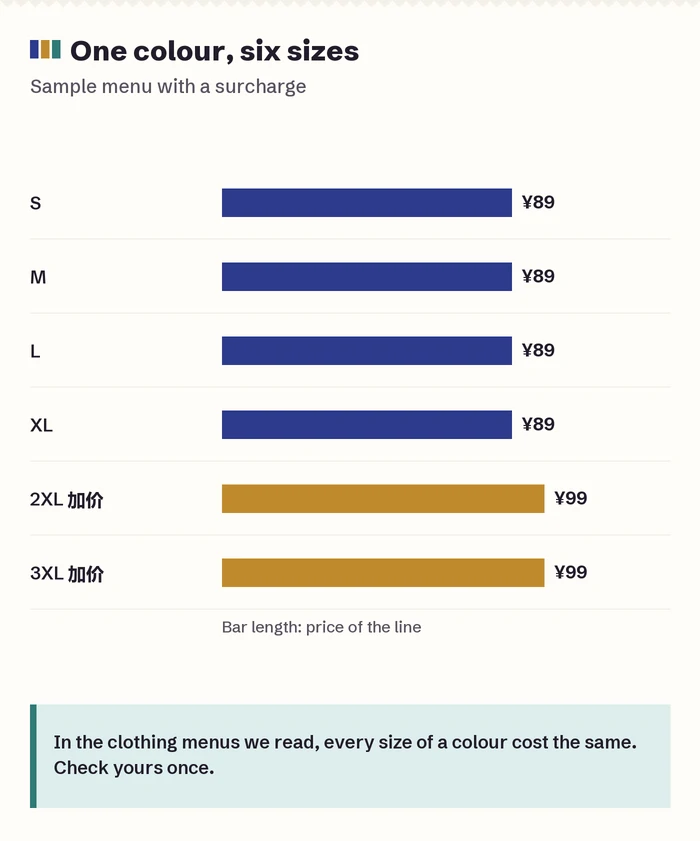
Every line in a menu can be priced on its own, and that includes sizes. When a seller charges more for the bigger sizes, the menu shows it in one of two ways: the price simply rises when you tap 2XL or above, or the size entry itself says so, as in 2XL-3XL 加价 (larger sizes, extra charge). Plus-size ranges that run to 5XL or 6XL are where sellers most often do this, because those pieces use more fabric.
The catalogue menus we read on 19 October 2026 told a different story from what we expected. Size moved the price inside a colour in only one of them, and that was a bag whose “sizes” were box dimensions. On the clothing listings, every size of a given colour or design cost the same; the price differences came from the first group.
So a surcharge is something to check rather than expect: tap your size once and watch the price. If it moves, the card price is two steps away from what you will pay.
Size names that carry more than a size
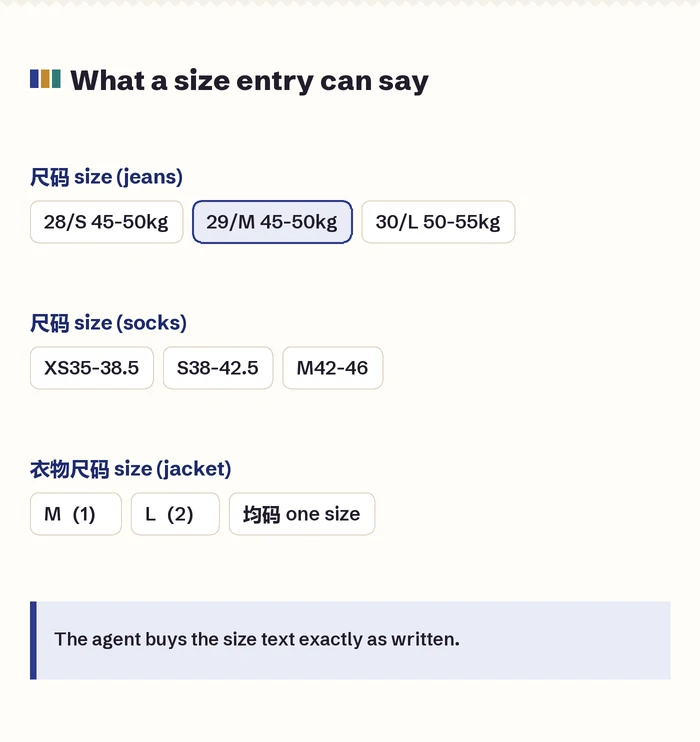
A size entry can carry extra information the size chart would normally hold. In the jeans menu we read, each waist size came with a body weight: 28/S 45-50kg, 29/M 45-50kg and so on. A sock listing wrote shoe-size ranges into its sizes, such as XS35-38.5. A jacket listing numbered its sizes, M(1), L(2), and a T-shirt listing named its size group after one particular style.
Treat these additions as the seller’s guidance and nothing firmer. Weight ranges in particular overlap and assume a build; they are a starting point for reading the size chart, not a replacement for it. What matters for the order is that the agent buys the size string exactly as written, so the line you pick should be the one whose name matches what you mean.
均码 means one size. A listing with 均码 has no size group at all, and the second group, if there is one, is usually something else.
When the second group is not size
The second option group is size on most clothing listings, but the heading is worth reading before you assume it. A socks listing we read used its second group for length, mid-calf (中筒袜) or long (长袜). Bags and hats often have a single group, with any size written into the entry names. A bag listing headed its second group 尺寸 and filled it with box dimensions, which is where the only size-based price step in our sample came from.
If the second group is not size, the size is somewhere else: inside the first-group names, in the description images, or fixed for the whole listing. Find it before choosing a line, because the agent will not guess on your behalf.
Checking a size line before you choose it
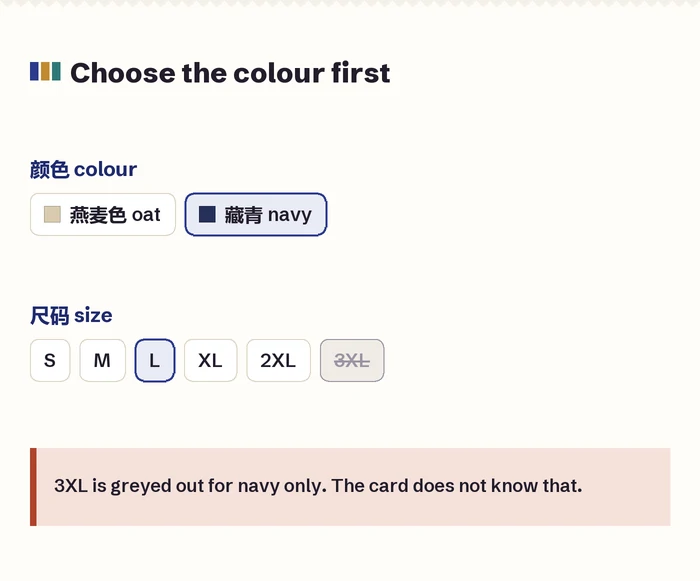
A size line has three things to read: its price, its stock and its exact name. On Weidian and Taobao a size that is out of stock for the colour you picked is usually greyed out once the colour is selected, so choose the colour first and the size second. If your size turns grey only for the colour you want, the seller does not have it, whatever the card says.
Once you have the line, copy its full text, colour and size together. That pair is what goes into the agent order, and it is what the warehouse photos should match later. If the size chart and the size name disagree, ask in the order notes which one the seller goes by.
Shipping weight follows the line, not the card
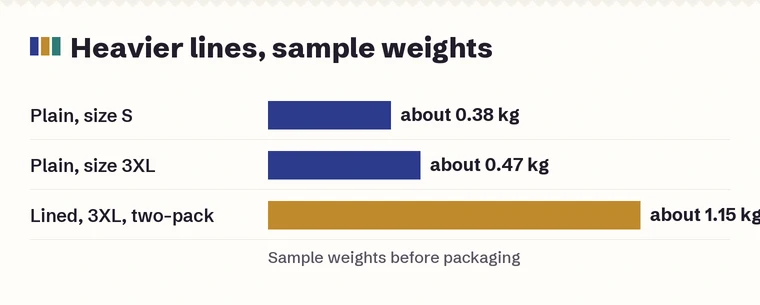
International delivery from an agent warehouse is normally charged by weight, and sometimes by size of box when the parcel is light but bulky. The line you pick decides both. A 3XL weighs more than an S, a fleece-lined version more than a plain one, and a two-pack twice as much as a single piece, before any box.
None of this shows on the card. When you compare two listings, the shipping cost of the line you would actually buy is part of the price, so a heavier lined line can cost more to send than it saved at purchase. The warehouse weighs what arrives; your estimate should start from the line, not from the photo.