
Gift boxes, odd pieces and other garments sitting in a clothing menu
The cheapest line of a listing is often a perfectly honest thing to sell. It just is not always the thing in the photo, and the card price follows it.
Options for a different item altogether
A listing’s option menu is a price list, and a seller can put anything on it. Most entries are versions of the item in the photo. Some are not: they are packaging, a matching piece, a cheaper garment, an add-on, or an entry whose purpose the name does not explain. Because these are usually cheaper than the main item, one of them tends to become the lowest line, and the lowest line is what the card shows.
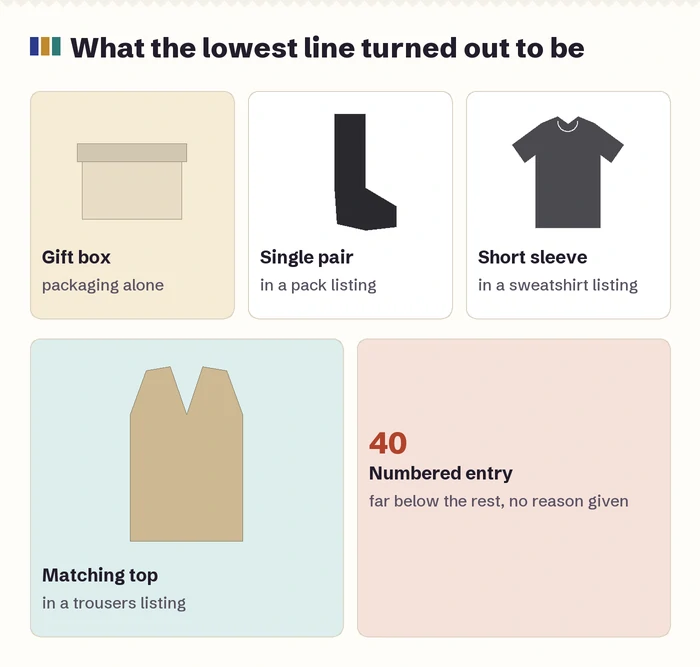
In the forty-eight menus we read on 19 October 2026, the kinds we met were a gift box sold alone, a single pair inside a multipack listing, a short-sleeve top inside a sweatshirt listing, a bra top inside a trousers listing, a waistcoat inside a jacket-and-trousers listing, and numbered entries priced far below their neighbours. Each section below takes one of them.
Packaging sold as its own line
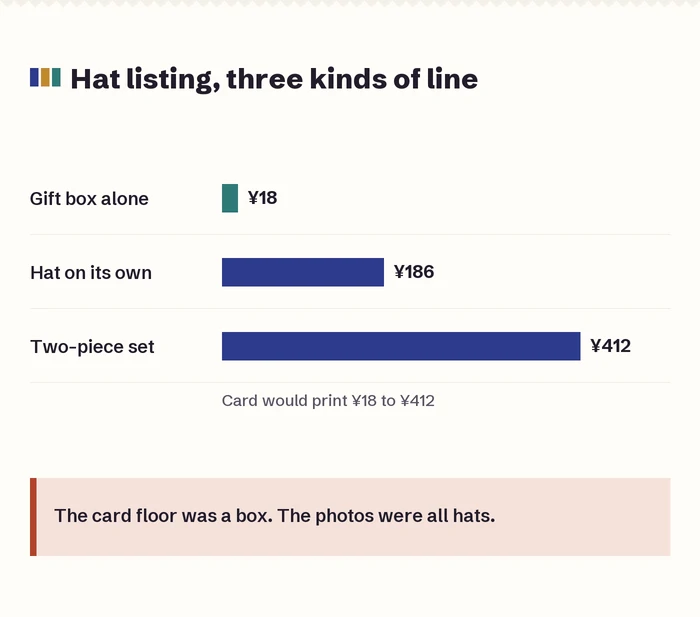
In the recorded hat menu, several gift-box options cost less than the hats and included a seller statement about transit damage and no returns. That statement describes what the seller wrote; it does not establish a waiver of remedies for every problem. Ask what the box option includes and how damage or a wrong item would be handled.
Packaging lines are familiar from shoe listings too, where box and no-box versions of the same pair are usually separate entries. If you want the item and the box, you may need two lines, or a line whose name includes both. If you only want the item, make sure the line you pick is not the box on its own.
A different garment under the same photo
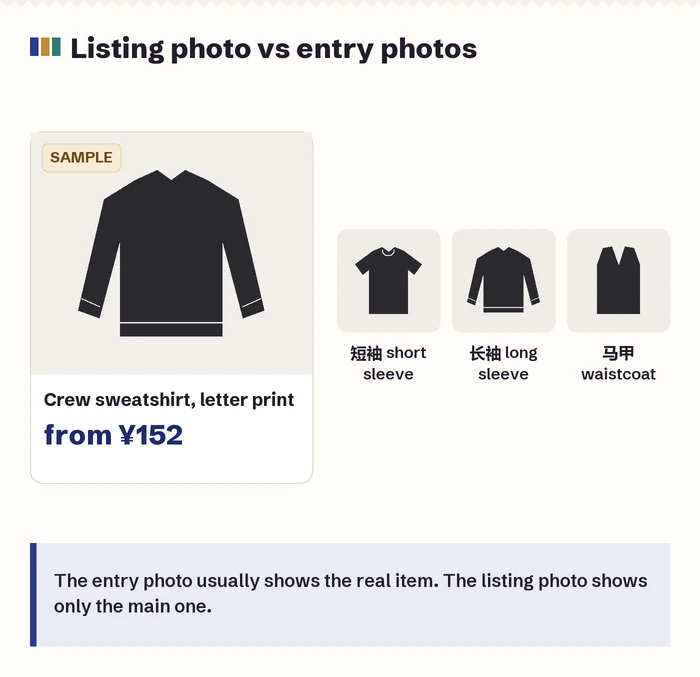
The listing photo shows one garment; the menu can sell several. In a sweatshirt listing, the three cheapest entries were short-sleeved tops. In a trousers listing, each colour had a trousers line and a cheaper bra-top line from the same set. A listing headed as sweatpants also sold jackets, waistcoats and full sets, each written into the colour list with a garment word in front: 外套 for jacket, 马甲 for waistcoat, 套装 for set.
The garment word is the giveaway, and it is usually at the start of the entry: 短袖 (short sleeve), 长袖 (long sleeve), 文胸 (bra), 裤子 or 长裤 (trousers), 外套, 马甲, 套装. The entry’s own photo usually shows it too, which is why the photo attached to the entry is worth more than the listing photo.
Add-ons and singles
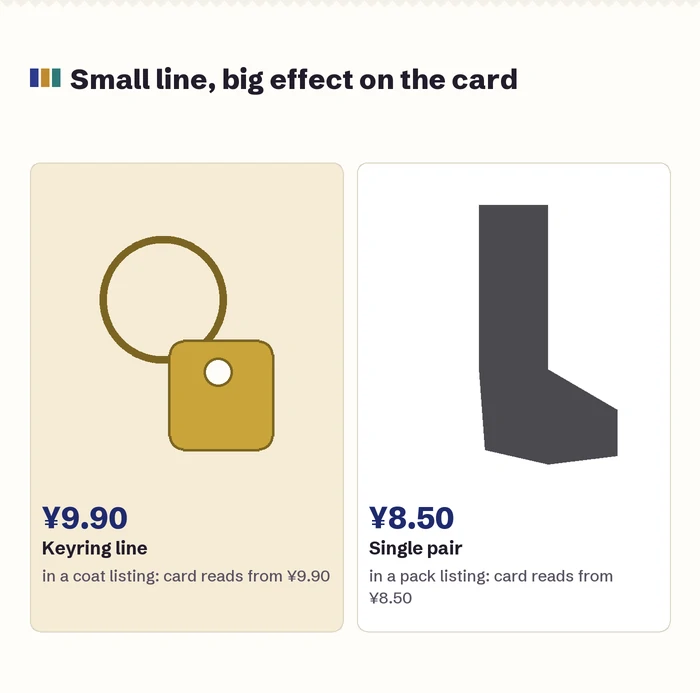
Small add-ons, such as a keyring, a sticker sheet or a printed paper bag, are sometimes sold as lines of a clothing listing so a buyer can add one to an order. None appeared in our sample, but the effect is easy to picture: an add-on at a few yuan becomes the floor of a listing selling coats.
The recorded socks menu offered one pair and packs of three and five. It does not establish which option buyers preferred. Divide the selected pack price by its stated pair count and confirm the colour mix; the lowest total price and lowest price per pair are different comparisons.
The sample menu on the home page includes a keyring line so you can see what it does to a card range.
Numbered entries priced far below the rest
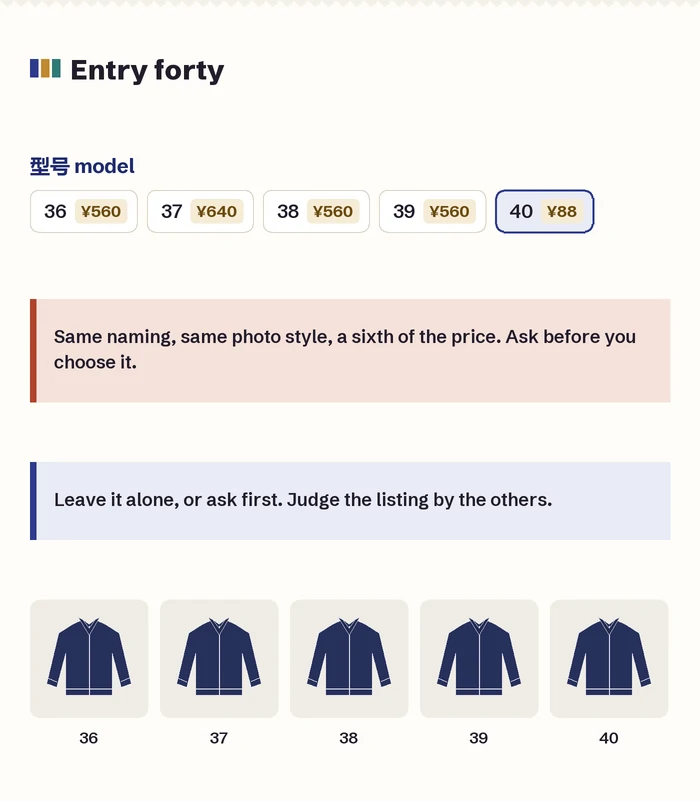
Two collection menus we read had a single numbered entry far below everything else. In one, entry forty cost about a sixth of the common price; in the other, entry forty sat well under the plain designs and a set sat at the top. Neither name said anything: just the number.
There are innocent explanations, from a child’s size to a sample to a typo in the price, and less useful ones, such as a placeholder that exists to make the card price look low. You cannot tell which from the menu, and neither can an agent’s purchaser, who will buy what the line says.
So open the entry’s photo. If it shows the same garment as its neighbours and no reason for the price, ask in the order notes before paying, or leave that line alone and judge the listing by its body price.
Spotting a filler line before you order
Review the chosen option, its photo, quantity and price before submitting it. A different option picture is a reason to clarify what is included, not proof of an error. This checklist has no measured detection rate or fastest-order claim.
- Find the cheapest entry and open its photo.
- Read the first word of its name for a garment word, a packaging word or a number with nothing else.
- Compare its price with the body price; a line far below is a question, not a deal.
- If the listing sells packs, divide by the count before deciding the single is cheaper.
- Write the line you actually want in Chinese, exactly, before you go to the agent.