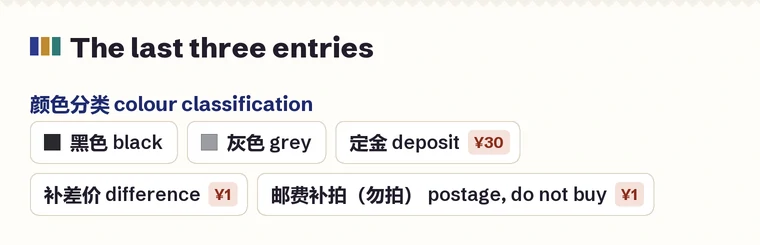
Payment-only options that look like the cheapest way in
A one-yuan option may be a deposit, an extra postage payment, an accessory or another item. The amount alone does not establish what is sold. Read the option and follow an explicit seller or agent instruction before purchasing a payment-only entry.
Deposit links, postage links and balance links
Some lines exist to collect money rather than to sell a product. A deposit line (定金) takes part of a price in advance; a balance line (尾款, or 补差价 when it covers a difference) takes the rest or an extra amount; a postage line (邮费补拍, sometimes 运费) collects delivery costs inside China. They can sit inside a product’s menu or be a whole listing of their own, often marked 专拍, a link meant for that purpose only.
None of the forty-eight catalogue menus we transcribed carried one, and searching the catalogue for those words on 19 October 2026 returned no listings. That fits how they are usually used: a seller points a particular buyer to them, for a custom order, a pre-sale or a parcel that needs extra postage. You meet them when a seller sends you one, or when you open a shop’s own pages rather than a catalogue card.
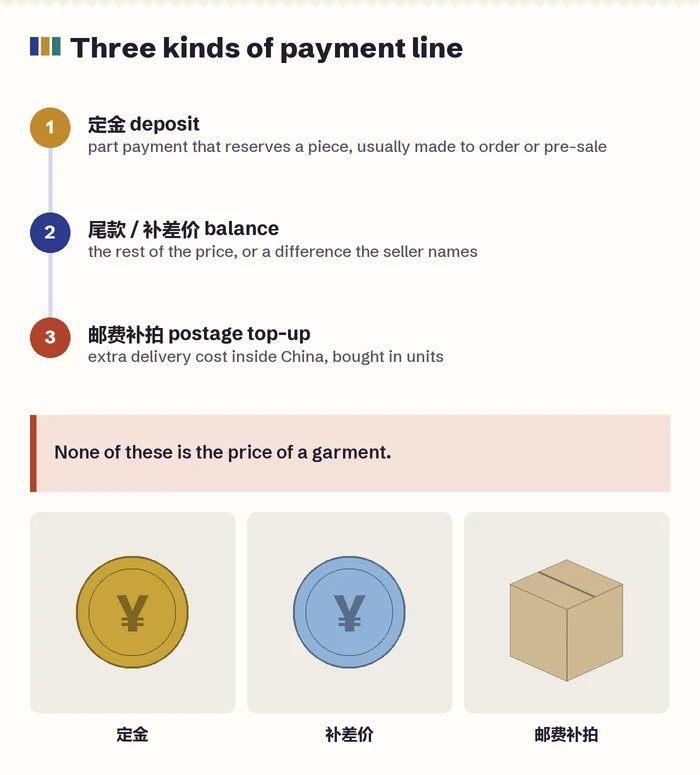
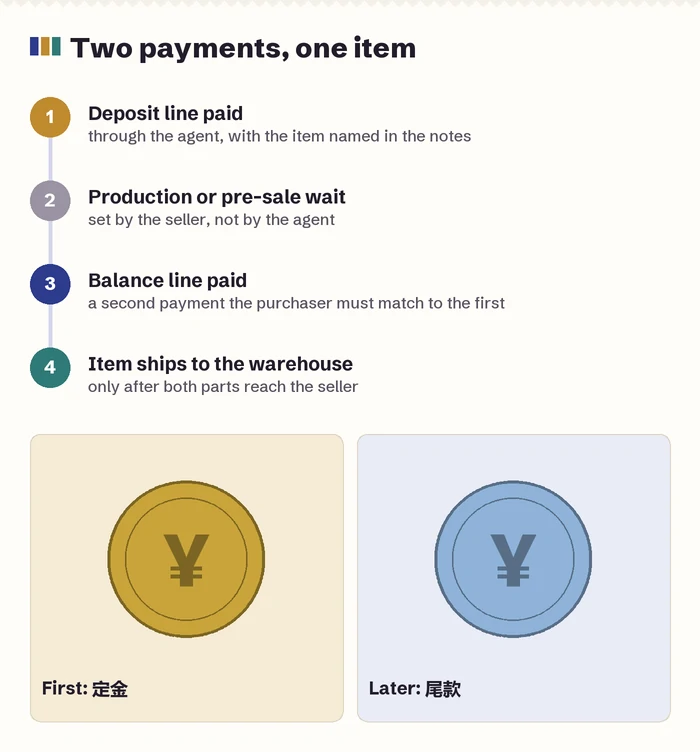
Deposit and balance: paying in two parts
Made-to-order and pre-sale pieces are sometimes paid in two parts: a deposit line now, a balance line later when the piece is ready. On some listings both parts are lines in one menu; on others the seller gives you a separate balance link once production finishes.
The deposit line is usually the cheapest entry in such a menu, and so the card price, although it buys nothing on its own. Through an agent, a two-part purchase needs both payments to reach the seller in the right order, and the purchaser needs to know which balance belongs to which deposit. Name the item and the deposit in the order notes when you pay the deposit, and expect a second step before the piece ships.
If a listing shows a deposit line and you did not plan a made-to-order purchase, the line is not for you.
Make up the difference: the one-yuan unit
补差价 lines and listings are usually priced at one yuan, sometimes one fen less or a round ten. The point is the quantity: to pay a difference of ¥15, a buyer orders fifteen units of the one-yuan line. Sellers use them when a buyer swaps to a dearer version, adds a service, or when a price changed between the buyer’s question and the purchase.
Because the unit price is so low, a 补差价 entry inside a product menu drags the card price down to one yuan. That one-yuan floor is the clearest sign that a card’s range starts on a payment line. When you see it, look for the real body price before you look at anything else.
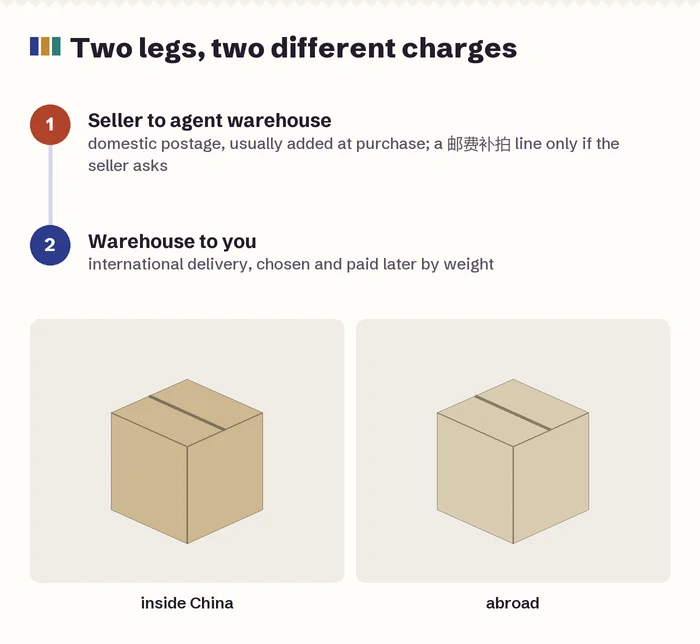
Postage top-ups inside China
邮费补拍 lines pay delivery costs the listing price does not cover: a remote address, an express option, or a second parcel when an order ships in parts. Like balance lines they are usually bought in one-yuan units.
An agent order changes the picture. The seller is not sending the item to you but to the agent’s warehouse in China, so the domestic postage is the seller’s ordinary rate to that city, and agents usually add it to the purchase themselves. A postage line should only come into an agent order when the seller asks for one, and then the reason belongs in the notes.
A postage line has nothing to do with international delivery, which you choose and pay for later, when the parcel leaves the warehouse.
When a seller asks you to use one
Sometimes a payment line is exactly right: the seller agreed to a dearer version, or a custom detail, and asks for the difference. On an agent order it becomes its own line with a quantity, bought alongside the item it belongs to.
- Add the payment link as a separate order line, with the quantity that makes up the amount.
- In the notes, name the product line it belongs to and what the seller agreed.
- Keep the seller’s message about it, in case the purchaser needs to show it.
- Check the warehouse photos for the version you paid the difference for.
Without a request from the seller, do not buy a payment line. The seller has no reason to send anything for it, and an agent has no item to collect.
Where payment lines hide in a menu
Inside a product menu, payment lines are usually the last entries of the first group, sometimes with 专拍 or 勿拍 (do not buy) in brackets. On a translated page they can come out as “freight”, “difference”, “deposit” or simply “link”, and the option photo is often a plain coloured square or a picture of text.
The things to watch for, in short: a one-yuan entry, an entry without a garment photo, and any of the words below.
- 定金
- deposit
- 尾款
- balance of a deposit purchase
- 补差价 / 差价
- make up the difference
- 邮费补拍 / 补运费
- postage top-up
- 专拍
- a link for one purpose only
- 勿拍
- do not buy this line