
When a colour name also picks the lining, the length or the ship date
Sellers put versions into the colour list because it is the first thing you open. The brackets beside a colour can change the garment more than the colour does.
Colour names that hide a second choice
The first option group on a clothing listing is usually headed 颜色 or 颜色分类, colour or colour classification. Sellers use it for whatever they most want you to choose first, and colour is only part of that. When a listing comes in versions, the versions go into the colour list as extra entries, because a second option group would multiply the number of lines.
The result is a colour list where some entries are a colour and some are a colour plus something else. The something else sits in brackets or before the colour word, and it can change the garment more than the colour does. The sections below take the common additions one family at a time, using wording from menus we read on 19 October 2026.
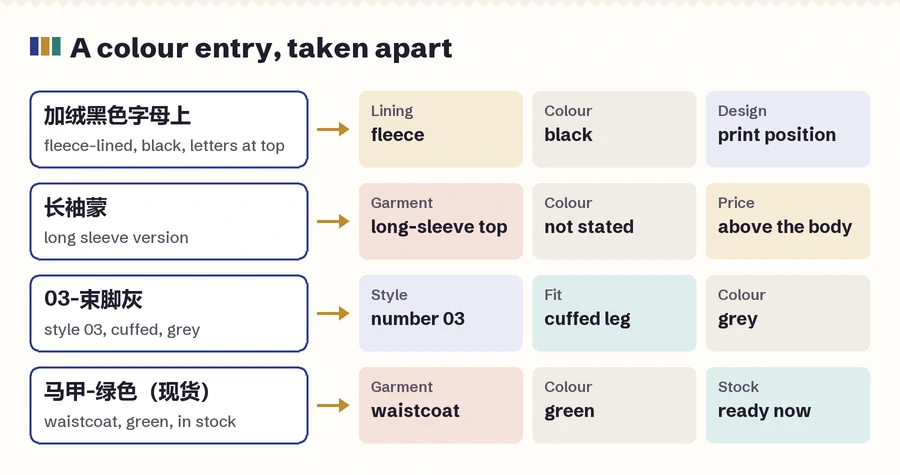
Lining and weight: 加绒, 加厚, 薄款
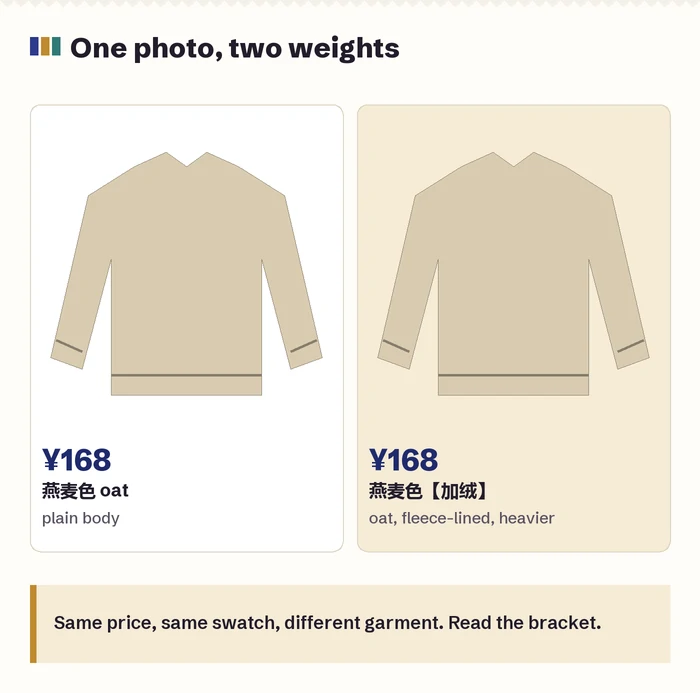
加绒 means fleece has been added inside, usually a brushed or plush lining; 加厚 means thickened; 薄款 is the thin version and 厚款 the thick one. On sweatshirts, hoodies and trousers these words split one design into a light garment and a winter garment that share a photo.
In one recorded sweatshirt menu, the 加绒 options cost the same as their plain counterparts. A price difference therefore cannot be relied on to identify the lining. Read the option wording and relevant photos, and clarify the construction if it affects your choice.
Lined versions also weigh more, which matters when international delivery is charged by weight, and they usually run a little smaller inside.
Length, sleeve and cut: 加长版, 短袖, 束脚
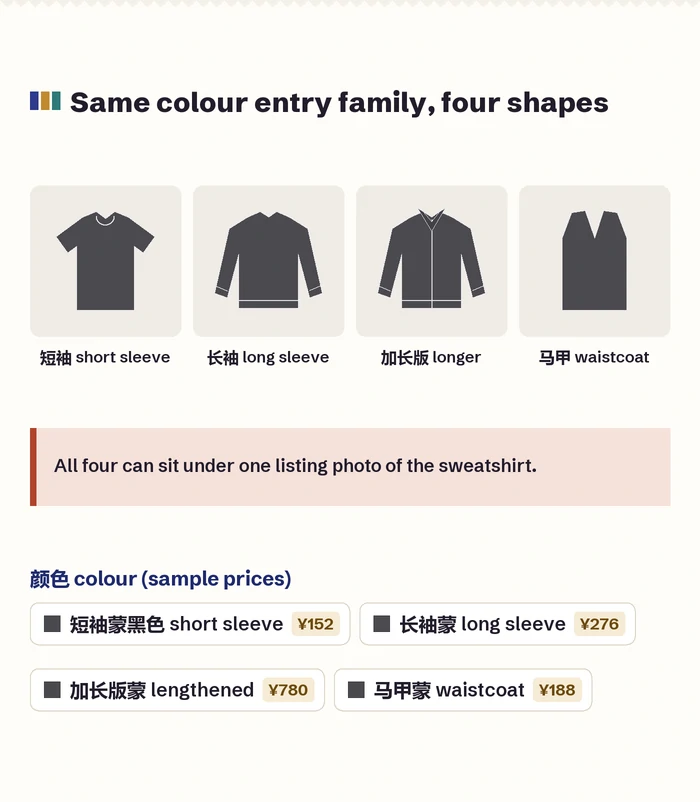
A second family changes the shape. 加长版 is a lengthened version; 短袖 and 长袖 are short and long sleeves; 宽松 is a loose cut and 修身 a fitted one; on trousers, 束脚 means elastic cuffs at the ankle and 直筒 a straight leg. 男款 and 女款 mark men’s and women’s cuts of the same design.
These words can change the garment completely. In one sweatshirt menu we read, the cheapest entries were short-sleeved tees, a long-sleeve version sat in the middle, and a lengthened version was the dearest line by a wide margin. All of them shared the listing photo of the sweatshirt. A trousers menu split each colour into cuffed and straight legs inside the colour list, so the size group never mentioned fit at all.
A jacket listing can carry a waistcoat (马甲) the same way: same fabric and colour, no sleeves, a different price.
Dates and stock words inside a colour
The wording 现货 claims in-stock availability; a phrase such as (9月25号发货) states a dispatch date. Neither proves live inventory or that dispatch occurred. The recorded trousers and waistcoat examples illustrate the wording, not a current promise for your order.
A dispatch date written in an option name is a seller statement to clarify, not proof of dispatch on that date. Ask what it means for your selected item and whether a date that has already passed is still applicable. International shipment depends on arrival and the later parcel stages.
Codes instead of names
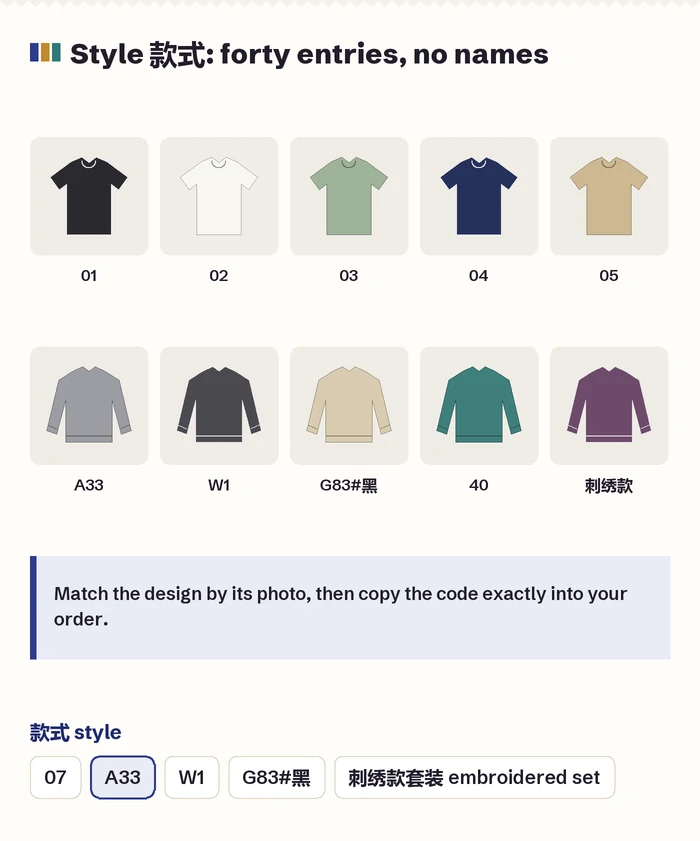
Many menus do not describe their entries at all. In our sample the first group was often headed 款式 (style), 型号 (model) or 类型 (type) and filled with numbers from 1 upward, letter codes like A33 or W1, or a seller’s stock code with a colour attached. These listings are collections: one link selling dozens of different designs, each entry a separate garment with its own photo and sometimes its own price.
Some captured menus ended at forty entries, but the sample does not establish a platform limit or how every seller splits listings. For a coded menu, compare the code, attached picture and description, then retain the exact option name you submitted.
A phrase such as 特价不退不换 states a seller’s proposed “special price, no returns or exchanges” condition. Save it and ask how cancellation, disclosed faults, wrong items and undisclosed defects would be handled. The phrase alone does not establish a waiver of every remedy or override applicable rules.
Option words, translated
These are the terms you will see most often in clothing menus, with the meaning that matters for choosing a line. The Chinese is what the seller wrote and what an agent buys; keep it next to any translation you rely on.
- 颜色 / 颜色分类
- colour / colour classification; the first group on most clothing listings
- 款式 / 型号 / 类型
- style / model / type; usually a list of separate designs
- 尺码 / 尺寸
- size; 尺寸 on bags and hats often means dimensions
- 套餐
- package; how many pieces or what comes with them
- 加绒 / 加厚 / 薄款
- fleece-lined / thickened / thin version
- 加长版
- lengthened version
- 短袖 / 长袖
- short / long sleeve
- 束脚 / 直筒
- cuffed ankle / straight leg
- 男款 / 女款
- men’s / women’s cut
- 现货 / 预售
- in stock now / pre-sale
- 两件装 / 三件套
- two-pack / three-piece set
- 假两件
- faux two-piece: one garment made to look layered
- 均码
- one size
- 定金 / 尾款 / 补差价
- deposit / balance / make up the difference
- 邮费补拍
- postage top-up line