
The low number on a card is an option’s price, not the item’s
Every card range we compared matched the cheapest and dearest line in the listing behind it. What those lines turned out to be is the part worth reading.
A range on the card, a price per option on the page
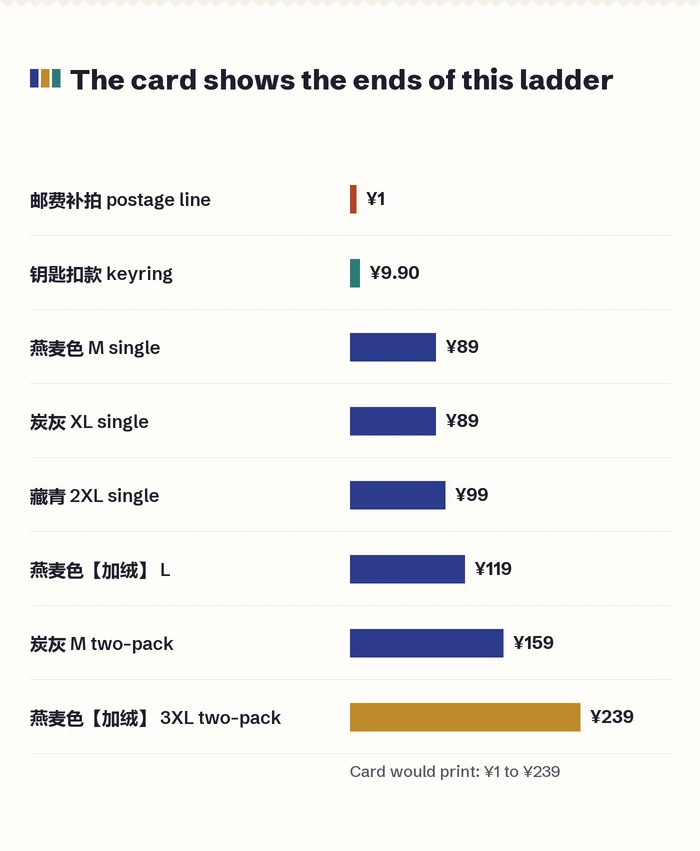
A Chinese listing is one page selling many lines. Each line is a combination of choices, such as a colour with a size, and each line has its own price and its own stock. When the listing is summarised on a card, in a marketplace search result or in a catalogue, there is room for one figure or two, so the card shows the lowest line and, where the prices differ, the highest.
We checked this on 19 October 2026 against forty-eight catalogue cards whose listings we could open without an account. On every one of them the low end of the card matched the cheapest line in the listing to the fen, and the high end matched the dearest line. The card is not wrong. It is a summary of a menu you have not read yet.
So the useful question is not whether the card price is real, but which line it belongs to and whether that line is the thing in the photo.
Which end of the range you are likely to pay
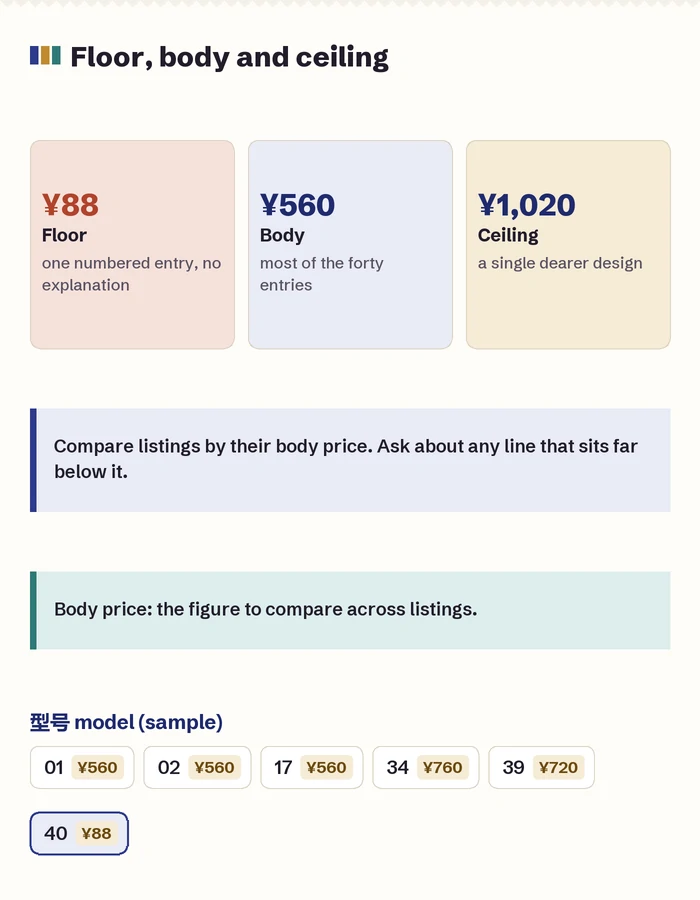
In the menus we read, prices did not spread evenly between the two ends. Most lines sat at one price, a handful sat above it, and now and then a single line sat far below everything else. One jacket menu had forty numbered entries: nearly all of them at one price, a cluster of dearer designs, and entry forty at roughly a sixth of the common price, with no word in its name to explain it.
The price repeated across many options describes the distribution of that menu, not what most buyers actually paid. Compare the specific variants you would order, with their included quantity and delivery costs.
When a single line sits far below the body, treat it as a question rather than a bargain. Open that line’s own photo, and if the photo does not answer it, ask before paying. It may be a sample size, a faulty piece, a deposit, a mislabelled entry or simply the seller’s mistake, and an agent buying on your behalf will buy exactly what the line says.
Yuan on the card, your currency at checkout
Catalogue cards and Chinese listings price in yuan (CNY, written ¥ or 元). Some catalogues offer a display in other currencies, which is a conversion at some rate on some day, useful for a rough sense and nothing more. An agent charges you in your own currency at its own exchange rate, and that is the rate you actually pay.
We could not check the CNFans rate: none of the saved copies of its pages showed one, and on 19 October 2026 cnfans.com showed only a maintenance notice. Whatever the rate, it applies to the line you pick, so a line that is ¥30 dearer than the floor is ¥30 dearer after conversion too. Convert the body price, not the floor, if you want a number to budget with.
Two things are usually missing from a card price altogether: the seller’s own postage inside China, which an agent normally adds to the purchase, and the international delivery you choose later. Neither changes which line you should pick, but both belong in the total.
Finding the line that sets the low end
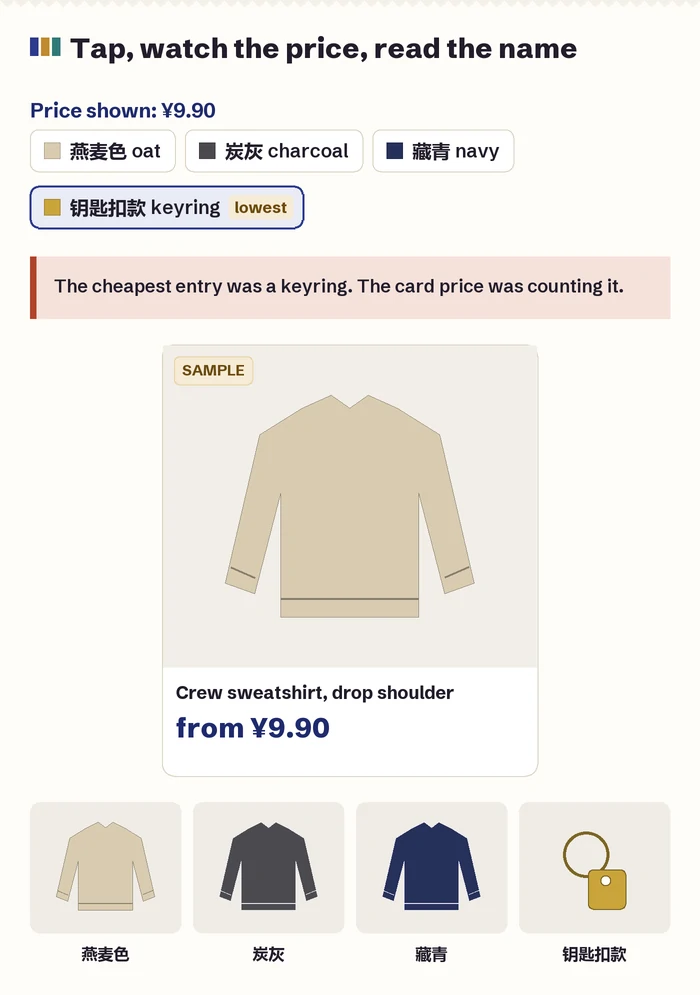
On the listing itself the price changes as you tap through the menu. On Weidian and Taobao the figure above the option buttons updates for each combination, and each entry in the first group usually has its own small photo. The quickest way to find the floor line is to tap down the first group with any size selected and watch for the drop.
- Open the listing behind the card, not just the card.
- Tap each entry in the first group and note where the price moves.
- For the cheapest entry, open its photo and read its full name, brackets included.
- Repeat with the second group in case a size or length line moves the price.
- Write down the body price and the line you actually want.
If the listing reaches you through an agent’s copied page, the option names may arrive machine-translated; the Chinese original is still the better guide, and the bracketed words in it carry most of the meaning.
Choosing an item by its typical line, not its floor
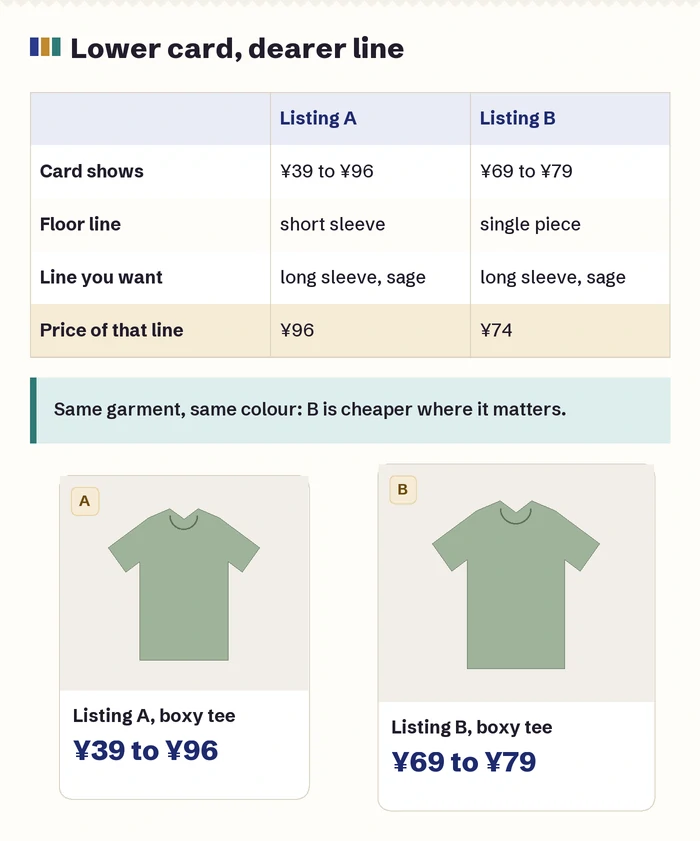
When you are deciding what to buy from a catalogue shelf, compare like with like: the body price of one listing against the body price of another, single piece against single piece, lined against lined. A listing whose card opens at ¥39 can turn out dearer than one opening at ¥69 once you reach the line you want.
Judging a listing this way takes a minute and saves the most common surprise on agent orders, which is not a scam or a fault but a line chosen for its price. Three habits cover most of it:
- Pick the line you want first, then look at its price, never the other way round.
- Treat a menu where every line has a different design and price as a collection, and judge the design you want on its own.
- Keep a note of the line name in Chinese; it is what the agent buys and what you check the warehouse photos against.